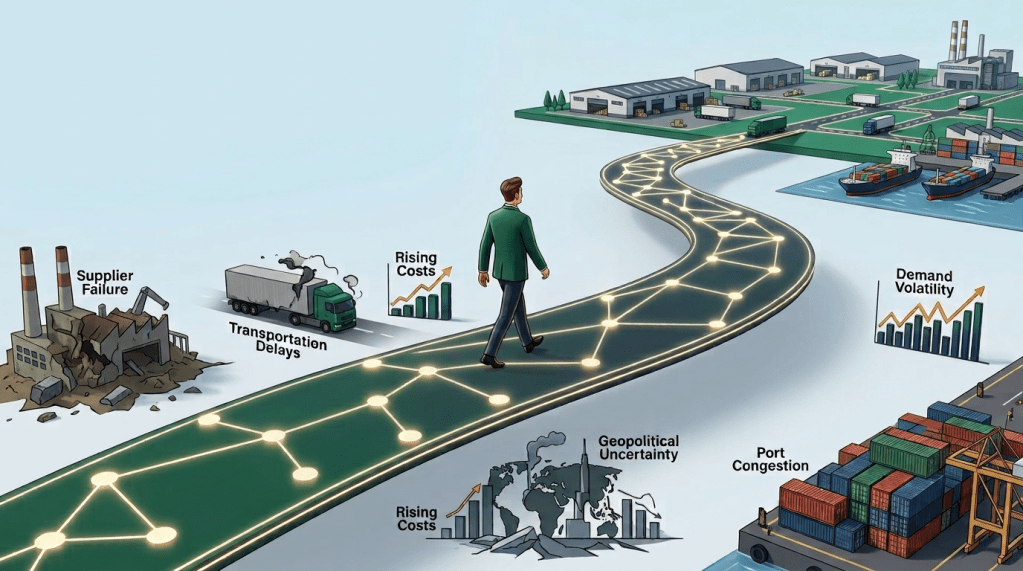
Every disruption asks the same question: Was your business prepared? Imagine arriving at work on a Monday morning to find this email waiting in your inbox:
“We regret to inform you that we are unable to fulfil your next order due to unforeseen circumstances. We apologise for the inconvenience.”
No timeline. No alternative supplier. No indication of when operations will return to normal. Just uncertainty.
For many SMEs, that single message would trigger a chain reaction.
Production slows ⇉ Sales orders are delayed ⇉ Customers begin asking questions ⇉ Cash flow comes under pressure.
Management scrambles to find another supplier often at a higher price and with longer lead times. Within days, what started as a supplier problem becomes a business problem.
Here’s the reality: The disruption itself isn’t usually what causes the greatest damage. It’s the lack of preparation before it happens.
Over the past few years, businesses across Africa have navigated global pandemics, shipping bottlenecks, foreign exchange volatility, geopolitical tensions, and rising logistics costs. These events have reinforced an important lesson: disruptions are no longer rare occurances, they are part of today’s business environment.
The question is no longer if your supply chain will be disrupted. It’s how prepared your business will be when it happens.
The Biggest Misconception About Supply Chain Resilience
When business owners hear the word resilience, many think of larger warehuses, higher inventory levels, more suppliers or expensive technology. It’s an understandable assumption but it can also be an expensive one.
Holding more inventory may protect you from one disruption while creating anther by tying up valuable working capital. Maintaining multiple suppliers without a clear strategy can increase complexity instead of reducing risk. Even the most advanced technology cannot compensate for poor planning or weak decision-making.
In our work with SMEs, one pattern appears repeatedly; the businesses that recover the fastest from disruption are rarely the ones with the biggest budgets, they are the ones that prepare the best. Resilience isn’t built by spending more, it is built by making better decisions before they are needed.
A Different Way to Think About Resilience
At AfriChain Insights, we have found that resilient businesses consistently excel in four areas. These observations form the basis of what we call the RISE Framework™, a practical approach designed to help SMEs strengthen their supply chains without unnecessary complexity or cost.
The RISE Framework: A Practical Blueprint for Building Resilient Supply Chains in African SMEs
The framework is built on four principles:
- Review your critical risks
- Improve visibility
- Strengthen supplier relationships
- Embed flexibility
R – Review Your Critical Risks
Not every supplier, product, or process carries the same level of risk. Yet many SMEs treat them as if they do. The first step is identifying what your business simply cannot operate without. Ask yourself:
- Which supplier would stop operations if they couldn’t deliver next week?
- Which product generates the largest share of your revenue?
- Which raw materials take the longest to replace?
If you don’t know the answers, you are not alone but you are exposed. Resilience begins with understanding where your business is most vulnerable.
I – Improve Visibility
Visibility is one of the most underestimated competitive advantages in supply chain management, you can’t respond quickly to problems you can’t see. It’s not about sophisticated dashboards or expensive software. It’s about having timely information to make confident decisions. Can you answer these questions today?
- Which inventory items are moving slowly?
- Which products are increasing in demand?
- Which suppliers are beginning to experience delays?
- How long will your current inventory last?
Businesses with better visibility make better decisions because they have more time to respond instead of making expensive reactions.
S – Strengthen Supplier Relationships
One of the biggest mistakes SMEs make is treating supplier relationships as purely transactional: orders are placed and invoices are paid. Communication happens only when something goes wrong. Resilient businesses take a different approach. They communicate regularly, share forecasts where possible, discuss challenges openly and build trust long before disruptions occur.
In uncertain times, relationships can become just as valuable as contracts. A supplier who understands your business is far more likely to support you during difficult periods than one who only hears from you when its time to place an order
E – Embed Flexibility
The businesses that recover fastest are not always the largest. They are often the most adaptable. Flexibility doesn’t require a complete redesign of your operations. Sometimes, it starts with asking better questions.
- Do we have an alternative supplier for critical materials?
- Can we adjust order quantities if demand changes unexpectedly?
- Do we have a documented response plan if our primary supplier experiences a disruption?
Small adjustments made today can prevent costly disruptions tomorrow.
Why This Matters for African SMEs
Across Africa, SMEs operate in environments where uncertainty is often part of doing business. Currency fluctuations can increase import costs overnight. Border delays can disrupt production schedules. Infrastructure challenges can affect distribution. Changes in trade policy can alter sourcing strategies.
While these realities cannot always be controlled, preparedness can. Businesses that invest time in understanding their risks, strengthening relationships, and improving visibility are often better positioned to continue serving customers when disruptions occur.
Resilience, therefore, is not just about protecting operations. It’s about protecting customer confidence, safeguarding cash flow, and creating a business that can continue growing despite uncertainty.
A Question Worth Asking
Imagine your most important supplier informed you today that they couldn’t deliver for the next 30 days.
What would happen tomorrow morning? Would your business continue operating with confidence? Or would everything stop while you searched for alternatives? Your answer may reveal more about your supply chain than any performance report ever could.
📘 Resource: Ready to put the RISE Framework™ into practice?
Download our ebook, The SME Playbook for Building Unbreakable Supply Chains, and discover practical tools, self-assessment checklists, and actionable strategies to help your business prepare for disruption and build a stronger, more resilient supply chain.
Final Thought
Every disruption asks the same question: Was your supply chain designed for yesterday’s world or tomorrow’s?
The businesses that will thrive over the next decade won’t be those that avoid disruption. They will be the ones that anticipate it, prepare for it, and recover faster than everyone else because resilience isn’t about spending more. It’s about thinking differently.
About the author
Daniel Ghartey-Mould, PMP, MCIPS is the Founder and Lead Consultant at AfriChain Insights Consulting, where he helps African SMEs build resilient, efficient, and future-ready supply chains. His work focuses on procurement transformation, supply chain resilience, AI-enabled planning, and operational excellence, translating complex supply chain challenges into practical strategies that improve business performance.


Leave a Reply